The Art of Breathing Room: Why Masterful Event Pacing Moves People More Than Any Single Moment
There is a common misconception in event production: that a successful event is a full event. Packed schedules. Back-to-back speakers. Entertainment that never pauses. The assumption is that constant stimulation signals value — that guests who are always occupied are guests who are always satisfied.
Experienced event designers know otherwise.
The most emotionally resonant events in premium production are not defined by relentless momentum. They are defined by rhythm — a carefully calibrated sequence of intensity and release, of spectacle and stillness, of sound and silence. Just as a skilled composer understands that a rest is not the absence of music but a part of it, a skilled event designer understands that a quiet moment is not dead air. It is an invitation for meaning to settle.
What Pacing Actually Means in Event Design
Pacing, in the context of premium event production, refers to the intentional management of energy across the arc of an event. It encompasses how long each segment runs, how transitions are handled, how the emotional register shifts from one moment to the next, and — critically — where moments of deceleration are placed to allow attendees to process what they have just experienced.
This is distinct from scheduling. A schedule tells you what happens and when. Pacing determines how each element feels in relation to everything around it. Two events can share an identical agenda and produce entirely different emotional outcomes based on nothing more than the texture of their transitions and the deliberateness of their pauses.
At the highest levels of event design, pacing is treated as a creative discipline in its own right — one that requires as much attention as lighting design, catering, or spatial layout.
The Psychology Behind the Pause
Human attention operates in cycles. Cognitive research consistently demonstrates that sustained high-intensity stimulation leads to diminishing emotional returns. When every moment competes for the same level of engagement, the brain begins to normalize the stimulation, and what was once exciting becomes background noise.
This phenomenon — sometimes called sensory adaptation — is the enemy of memorable events. It is why a gala that front-loads every impressive element often leaves guests feeling curiously underwhelmed by the time the evening concludes. The crescendo loses its power when there is no valley to contrast it.
Deliberate quietude serves a neurological function. When the pace slows — when a speaker pauses meaningfully, when ambient music fades to near-silence before a key announcement, when guests are given unstructured time to absorb a newly revealed environment — the brain shifts from processing mode into consolidation mode. Emotions deepen. Memories form. The experience moves from the surface into something more lasting.
Transitions as Narrative Devices
One of the most underestimated tools in a premium event designer's repertoire is the transition. In lower-tier productions, transitions are logistical necessities — the time it takes to clear a stage or move guests from one room to another. In premium production, transitions are narrative devices.
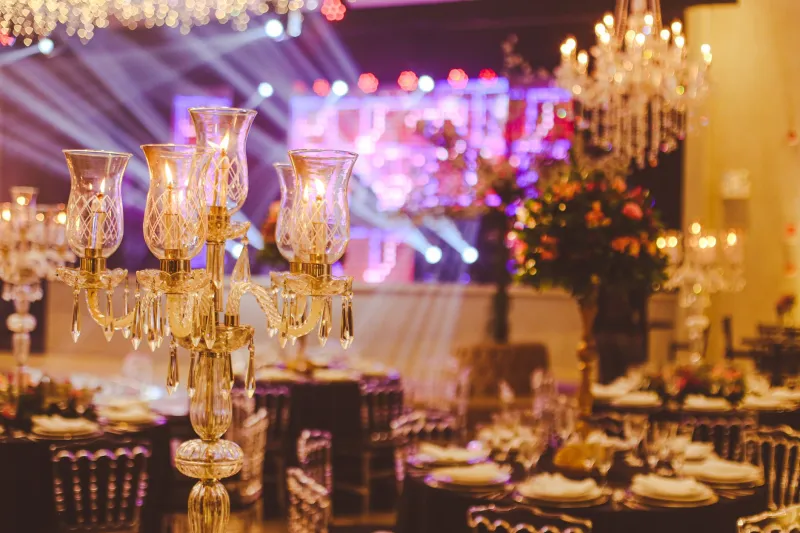
Consider a corporate milestone gala that moves guests from a cocktail reception into a main ballroom for dinner and a program. A standard transition involves opened doors and a host announcement. A designed transition might involve a deliberate dimming of the reception space, a shift in the ambient soundscape toward something more anticipatory, a brief moment of near-darkness before the ballroom doors reveal a fully illuminated environment — all within ninety seconds.
The guests have not simply moved rooms. They have crossed a threshold. The transition itself has communicated that something significant is about to occur, priming them emotionally for what follows.
This kind of intentional transition design requires close collaboration between the creative director, the audio-visual team, and the venue operations staff. It is detailed, exacting work — and it is precisely the kind of work that distinguishes quality event production from event logistics.
Designing Against Fatigue
Attendee fatigue is a genuine risk at high-stakes events, particularly those spanning multiple hours or multiple days. Conferences, awards ceremonies, multi-day retreats, and large-scale corporate summits all carry the potential for the audience to mentally check out long before the program concludes.
Strategic pacing is the primary countermeasure.
In practice, this means resisting the temptation to fill every available minute. It means building in what designers sometimes call "breath moments" — brief, low-demand intervals where guests can move, converse informally, or simply exist without being directed. It means sequencing high-energy segments against lower-intensity ones, so that the program has natural peaks and valleys rather than a sustained plateau.
It also means being honest about duration. A ninety-minute program with excellent pacing will consistently outperform a two-and-a-half-hour program that overstays its welcome. The discipline to edit — to cut the segment that is good but not essential, to shorten the video package by forty-five seconds, to trust that less will land harder — is one of the defining qualities of experienced event designers.
The Role of Sound in Emotional Pacing
Audio is perhaps the most powerful pacing tool available in event production, and it operates largely below the level of conscious awareness. Background music tempo directly influences perceived time and energy levels. A subtle shift from a 128-BPM ambient track to something in the 70-BPM range can physically slow a room's energy within minutes — a technique used deliberately to ease guests into a more reflective state before a keynote or a tribute.
Silence itself, used sparingly and with intention, carries enormous weight. A skilled emcee who pauses for three full seconds after delivering a significant statement allows that statement to exist on its own — to fill the room without competition. Most untrained hosts rush past their most important lines, unconsciously denying them the space they need to resonate.
Sound design at premium events is not an afterthought. It is a continuous, dynamic element of pacing — one that should be mapped against the emotional arc of the program from the earliest stages of production planning.
Building the Emotional Arc
Every premium event has — or should have — a deliberate emotional arc. This is the overall shape of the experience: where it begins emotionally, how it builds, where it reaches its peak, and how it resolves. The arc is not accidental. It is designed.
Pacing is the mechanism by which that arc is executed. Without intentional pacing, even the most beautifully designed event risks feeling like a collection of unrelated moments rather than a coherent, meaningful experience.
The goal is not to engineer emotion artificially. It is to create the conditions in which genuine emotion can arise — and to give it the space to be felt fully. That requires restraint as much as ambition. It requires the confidence to let a moment breathe, to trust the silence, and to understand that the space between the songs is not empty.
It is where the music lives.