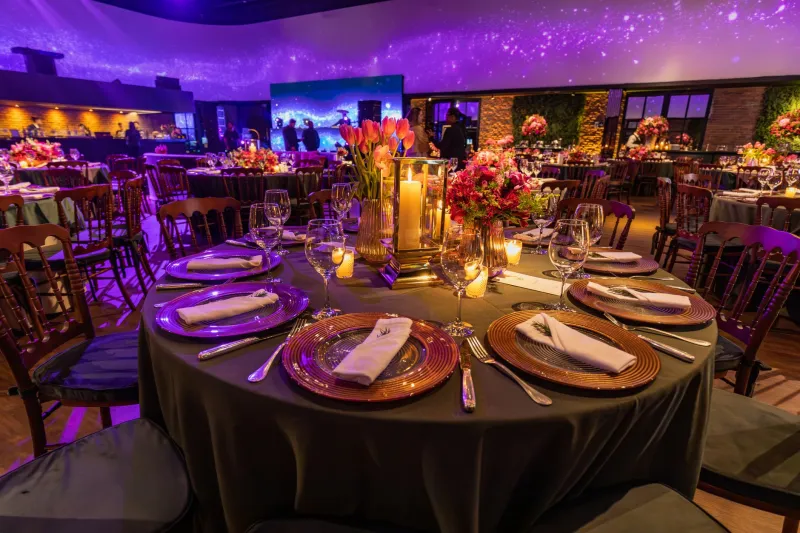
Rethinking the Numbers: Why Percentage-Based Budgeting Produces Better Events

There is a moment in nearly every initial client consultation when a spreadsheet appears on the table. It is color-coded, meticulously organized, and almost always wrong — not in its arithmetic, but in its philosophy. Line-item budgeting feels responsible. It feels controlled. And for the vast majority of premium events, it quietly dismantles creative vision before the design process ever begins.
The problem is not discipline. The problem is framing.
When clients approach an event budget as a collection of isolated costs — a fixed number for florals, a fixed number for catering, a fixed number for audiovisual — they are essentially designing in silos. Each category competes for dollars rather than contributing to a unified experience. The result is an event that may technically hit every number on the page while failing to resonate with a single guest in the room.
At Quality Event Design, we have seen this pattern repeat itself across corporate galas, milestone celebrations, and multi-day conferences. The solution is not more granular spreadsheets. It is a fundamentally different way of thinking about where money goes and why.
The Psychology Behind Guest Perception
Before any allocation conversation begins, it is worth understanding what guests actually notice. Research in experiential design consistently points to a handful of sensory anchors that shape lasting memory: arrival atmosphere, ambient sound and lighting, food and beverage quality, and moments of unexpected delight. Notably absent from that list are the things that cost event planners significant time and money behind the scenes — equipment rentals, logistics coordination, permitting, and production infrastructure.
This does not mean those elements are unimportant. It means they are invisible when they work correctly. Guests do not applaud a flawless load-in. They do not toast to a well-negotiated venue contract. They remember the way the room felt when they walked in, the quality of the conversation the environment encouraged, and whether the evening surprised them.
A line-item budget treats the invisible and the visible as equal. A percentage-based framework does not.
How Proportional Allocation Works in Practice
The percentage-based approach begins by dividing a total event budget into weighted categories that reflect guest impact rather than vendor categories. While precise allocations vary depending on event type, scale, and objectives, a general framework for premium events in the US market tends to distribute investment along the following lines:
Guest-Facing Experience (45–55%): This is the largest single allocation and encompasses everything a guest directly encounters — décor and environmental design, food and beverage, entertainment, and interactive programming. This is where creative vision lives, and protecting this portion of the budget is the most reliable way to ensure the event resonates.
Production and Technical Infrastructure (20–25%): Lighting design, audiovisual systems, staging, and power distribution are the skeleton beneath the skin of any well-produced event. Underinvesting here does not save money — it creates failures that no amount of beautiful florals can recover from. The goal is sufficiency, not excess.
Venue and Logistics (15–20%): Location, transportation, and the operational framework that keeps an event running on time. In major US markets — New York, Los Angeles, Chicago, Miami — venue costs can exert pressure on this percentage, which is precisely why the broader framework must remain flexible.
Contingency and Creative Reserve (8–12%): This is the category most line-item budgets eliminate entirely, and it is the one that most reliably separates adequate events from exceptional ones. A contingency fund is not an acknowledgment of failure — it is the financial permission to say yes to an unexpected opportunity on the day of the event.
Where Line-Item Thinking Goes Wrong
Consider a hypothetical corporate anniversary event with a $150,000 total budget. A line-item approach might assign $12,000 to florals because that number feels proportionate to past events. A percentage-based approach asks a different question: what role does environmental design play in this particular experience, and what share of the total investment should it command?
If the venue is architecturally neutral — a hotel ballroom, a convention space, a converted warehouse — environmental design may need to carry more weight, perhaps 18 to 22 percent of the total, to transform the space into something that reflects the brand or occasion. If the venue is inherently dramatic, that allocation can shift toward programming or culinary experience instead.
The line-item approach locks the number before the strategy is defined. The percentage approach lets strategy define the number.
This distinction matters enormously when clients begin negotiating with vendors. A planner working from fixed line items is perpetually defending specific dollar amounts. A planner working from percentages is defending proportional logic — a far more persuasive position when a preferred vendor's quote comes in higher than anticipated.
Communicating the Framework to Clients
One of the most valuable outcomes of percentage-based budgeting is the conversation it enables. When a client understands that guest-facing experience represents roughly half of their investment, they begin to make different decisions. They stop asking whether the centerpieces are worth the cost and start asking whether the centerpieces are the right vehicle for that portion of the budget — or whether live music, a signature cocktail program, or a custom photo installation might create more impact per dollar.
This reframing also helps clients understand why certain behind-the-scenes costs are non-negotiable. A client who sees audiovisual listed as a line item may instinctively look for ways to reduce it. A client who understands that technical production represents a structural percentage of any well-executed event is far less likely to make cuts that compromise the entire experience.
Transparency is not just a values statement at Quality Event Design — it is a design tool. When clients understand the logic behind allocation, they become partners in protecting the vision rather than adversaries in a negotiation.
Designing for Impact, Not Compliance
Premium event design is ultimately an exercise in priorities. Every dollar spent on one element is a dollar not available for another, and no budget — regardless of size — is immune to that constraint. The question is never whether to make trade-offs. The question is whether those trade-offs are made deliberately, with a clear understanding of what guests will experience as a result.
Percentage-based budgeting does not eliminate difficult decisions. It ensures that those decisions are made with the guest experience at the center, rather than as an afterthought to a spreadsheet that was never designed to carry creative weight.
The events that guests remember years later were rarely the ones with the largest budgets. They were the ones where every dollar was allocated with intention — where the numbers served the experience, rather than the other way around.