Designing Without Direction: How Expert Event Environments Shape Guest Behavior Naturally
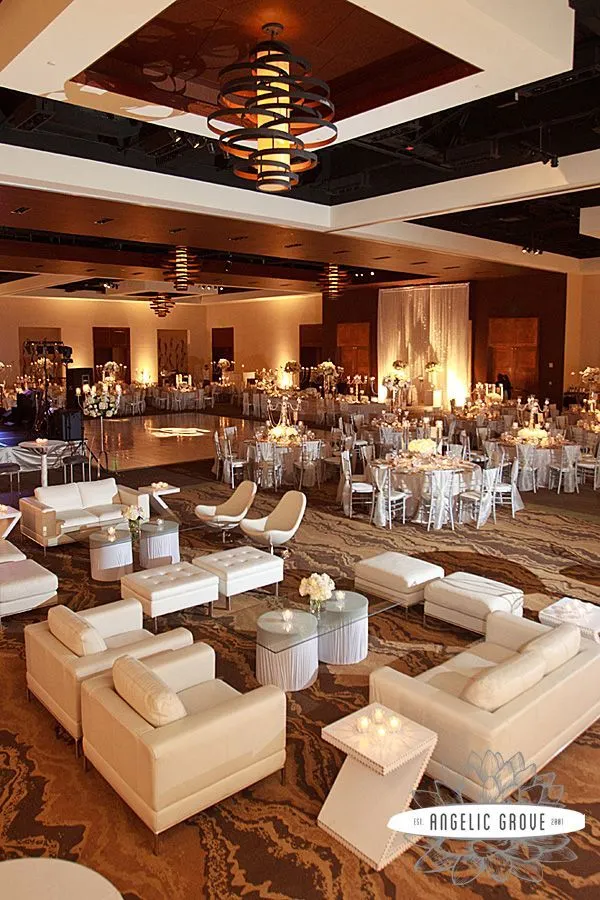
Photo: elegant event space interior design furniture arrangement cocktail reception, via i.pinimg.com
Consider the last event you attended where everything simply felt right. Conversations flowed effortlessly. You found yourself in the right place at the right moment. You encountered people you might never have sought out deliberately, and yet the exchange felt entirely natural. Chances are, you attributed that ease to good luck or a particularly convivial crowd.
You were wrong. What you experienced was masterful design.
At the highest level of event production, the most powerful forces shaping your experience are the ones you never consciously register. The angle of a furniture grouping. The placement of a bar station. The deliberate interruption of a sightline. These are not incidental choices—they are calculated decisions grounded in spatial psychology, behavioral science, and decades of refined craft. Together, they constitute what event designers call invisible choreography: the art of guiding people without ever appearing to lead them.
Why Explicit Direction Undermines Premium Experiences
There is an inherent tension at the center of event design. Organizers want specific outcomes—mingling, discovery, emotional resonance—but heavy-handed programming to achieve those outcomes almost always produces the opposite effect. Forced icebreakers create awkwardness. Rigid seating assignments generate resentment. Overly scheduled agendas make guests feel processed rather than hosted.
The solution is not to abandon intention. It is to embed intention so deeply into the environment itself that it becomes indistinguishable from atmosphere. When design works at this level, guests feel a sense of agency and spontaneity even as they move through a space that has been engineered with extraordinary precision.
This is the foundational philosophy behind premium event design: the environment should do the work that programming cannot.
The Language of Flow
Guest movement through a space is rarely random, though it often feels that way to participants. Experienced designers understand that human beings are remarkably predictable in how they navigate environments—and they use that predictability as a tool.
Entry points establish the first behavioral cue. A grand, open arrival foyer signals one kind of event; a narrow, intimate corridor leading into an expansive room signals another. The transition itself—from compressed to expansive space—triggers a psychological release that primes guests for social openness before a single word of welcome has been spoken.
Beyond the entry, traffic patterns are shaped through what designers call anchor points: destinations within the space that draw guests organically. A statement floral installation, a dramatically lit bar, an unexpected lounge vignette tucked into an alcove—each functions as a gravitational center, pulling guests through the room and ensuring that no single area becomes overcrowded while others sit empty.
The distance between anchor points matters enormously. Placed too close together, they concentrate guests in tight clusters that feel claustrophobic and make it difficult for natural conversations to form and dissolve. Spaced too far apart, they fragment the energy of the room and create dead zones. Expert designers calibrate these distances with the same precision a composer applies to tempo.
Furniture as a Behavioral Script
If flow patterns are the grammar of spatial design, furniture arrangement is the vocabulary. Every seating configuration communicates a set of behavioral expectations to guests, often before they are consciously aware of having received any instruction at all.
Lounge seating arranged in open-sided groupings—two sofas facing each other with an open end rather than a closed square—invites newcomers to join an existing conversation without the social cost of interrupting a closed circle. High-top tables near bars encourage brief, standing interactions that naturally conclude and allow guests to circulate onward. Lower, more intimate seating areas signal an invitation to linger, to go deeper in conversation, to settle rather than drift.
The height of seating surfaces also matters in ways guests rarely articulate but consistently feel. Uniform seating heights across a grouping create a sense of equality and ease. Mixed heights—a lower chair beside a standard-height seat—introduce a subtle power differential that most guests find subtly uncomfortable, even if they cannot name the source of their unease.
For this reason, premium event designers are meticulous about furniture selection not merely as an aesthetic exercise, but as a behavioral one.
Sightlines and the Architecture of Discovery
One of the most underappreciated tools in the event designer's repertoire is the deliberate manipulation of sightlines—what guests can see from any given point in the room, and, equally importantly, what they cannot.
A fully visible room, where every element is apparent upon entry, offers no sense of discovery. Guests absorb the environment in a single glance, form an immediate impression, and settle into whatever position feels most comfortable. The result is a static social geography: early arrivals claim territory, and latecomers fill in around them.
By contrast, a room designed with partial obscuration—tall floral arrangements that block views across the space, translucent drapery panels that hint at what lies beyond, architectural elements that create distinct zones within a single room—compels guests to explore. Curiosity becomes the engine of circulation. Guests move through the space not because they have been directed to, but because the environment rewards movement with new discoveries.
This principle of revealed experience is borrowed directly from landscape architecture and museum design, fields that have long understood that the journey through a space shapes the emotional experience of arriving at any destination within it.
Environmental Cues and Emotional Priming
Beyond the physical arrangement of elements, skilled designers use sensory cues to establish behavioral norms without a single explicit instruction.
Lighting intensity is among the most powerful of these cues. Brighter, cooler light activates alertness and encourages upright posture and focused interaction—appropriate for networking receptions or cocktail hours where broad social circulation is the goal. Warmer, lower lighting signals intimacy and relaxation, naturally shifting guests toward deeper, more sustained conversation. Moving between these lighting environments within a single event can effectively shift the social register of the entire room without any announcement or transition remark from a host.
Acoustic design operates similarly. A room with hard surfaces and high ceilings amplifies ambient noise, which paradoxically encourages louder, more animated, shorter exchanges—ideal for high-energy receptions. Softer surfaces, lower ceilings, and acoustic dampening create a quieter environment where guests naturally lower their voices and lean in, which produces more intimate conversation. Many event designers now work closely with acoustic consultants to engineer these environments deliberately, rather than accepting whatever the venue provides.
Scent, though rarely discussed in mainstream event planning, is another powerful environmental primer. Subtle ambient fragrance—deployed through diffusers or incorporated into floral selections—can evoke specific emotional associations that shape how guests experience a space before they have registered a single visual detail.
The Designer's Responsibility
Invisible choreography carries an ethical dimension worth acknowledging. The power to shape behavior without guests' awareness is a significant one, and it carries a corresponding responsibility to use that power in service of the guest experience rather than at its expense.
The finest event designers approach spatial psychology not as a mechanism for manipulation, but as a form of hospitality—a commitment to creating conditions in which guests can be their best, most open, most connected selves. When design succeeds at this level, the result is not control. It is liberation: guests freed from awkwardness and uncertainty, moving through a space that makes ease feel effortless.
That, ultimately, is the highest ambition of premium event design. Not to manage an experience, but to make a magnificent one feel inevitable.