When Less Becomes More: How Constraints Unlock the Most Memorable Event Design

Photo: Lodz Design, Public domain, via Wikimedia Commons
There is a quiet paradox at the heart of premium event design: the productions that guests remember most vividly are rarely the ones with the largest budgets. They are the ones where a designer, pressed against a wall of restrictions, found an opening no one else had considered. Budget ceilings, unconventional venues, compressed timelines, and logistical obstacles have a way of forcing exactly the kind of focused, inventive thinking that unlimited resources tend to suppress.
This is not a consolation argument for underfunding important events. It is an observation about creative psychology — and about how the most skilled designers in the industry have learned to treat every constraint as a design brief in disguise.
The Problem with Infinite Resources
When money and time are effectively unconstrained, decision-making expands to fill the space available. Options multiply. Revisions accumulate. The pursuit of perfection through addition — more florals, more lighting rigs, more entertainment — can produce events that are technically impressive but experientially diffuse. Guests move through them without a clear sense of intention, because the design itself lacked the pressure that produces clarity.
Constraint, by contrast, forces prioritization. When a design team cannot do everything, they must determine what matters most. That process of elimination is where genuine creative identity is born. A signature moment is not conceived in a room where every idea is equally affordable. It emerges when a team asks: given what we cannot do, what can we do that no one else would think to try?
A Venue That Said No to Everything
Consider the challenge of a corporate gala hosted in a historic building in the Mid-Atlantic region — a venue with strict restrictions on open flame, adhesives, load-bearing limitations on its original flooring, and a prohibition on any modifications to its ornate plasterwork. On paper, it read as a list of everything a traditional event design approach would require.
Instead of treating those restrictions as obstacles, the design team reoriented the entire aesthetic around them. Without candles, they introduced layered, warm-toned LED installations that mimicked candlelight at low intensity and were suspended from freestanding armatures rather than attached to any surface. Without the ability to drape or pin fabric to walls, they used furniture groupings and floral columns to create intimate zones within the grand space. The result was an environment that felt both historically reverent and distinctly contemporary — a combination that would have been far harder to achieve if the team had simply been allowed to transform the room in the conventional way.
Guests described it afterward as the most atmospheric event they had attended in years. The constraints had produced a design language specific to that space, that evening, and that client — which is precisely what premium event design is meant to accomplish.
Timeline Pressure as a Creative Catalyst
Compressed production schedules present a different category of constraint, but operate on a similar principle. When a nonprofit organization in the Pacific Northwest required a fully produced fundraising gala with less than six weeks of lead time — roughly half the standard runway for an event of its scale — the immediate instinct might be to scale back ambition.
Instead, the production team used the timeline as an editorial filter. Every design element had to justify its inclusion not only on aesthetic grounds but on logistical ones. Could it be sourced domestically within ten days? Could it be installed in under four hours? Could it be managed by a reduced crew? The answers to those questions shaped a design that was leaner, more cohesive, and more intentional than many events produced with twice the preparation time.
The centerpiece of the evening — a large-format projection installation that transformed the venue's rear wall into a living narrative of the organization's impact — was chosen in part because it required no physical fabrication and could be programmed remotely. What began as a practical compromise became the most emotionally resonant element of the night, drawing guests into the organization's story in a way that a traditional display or printed program never could.
Budget Limitations and the Discipline of the Focal Point
Perhaps the most instructive constraint is the budget ceiling, because it demands a clarity of vision that abundance rarely requires. When a design team cannot invest equally in every aspect of an event, they must identify the single experience they most want guests to carry with them — and then concentrate resources there.
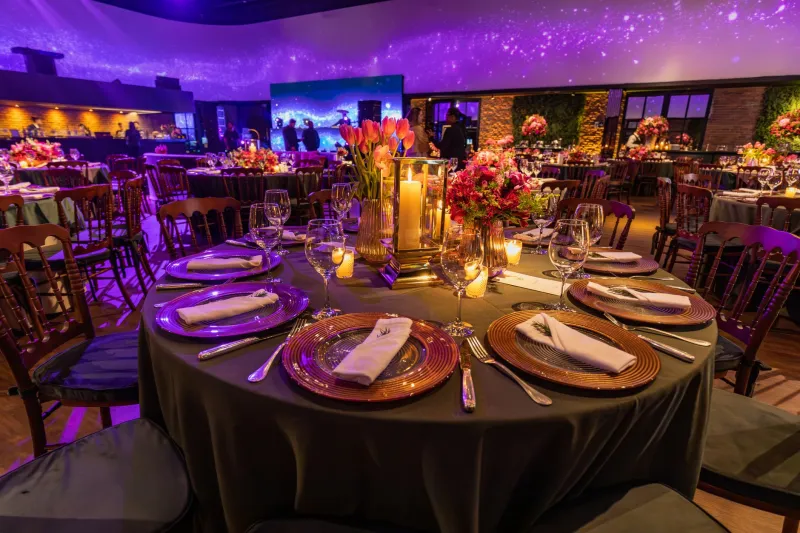
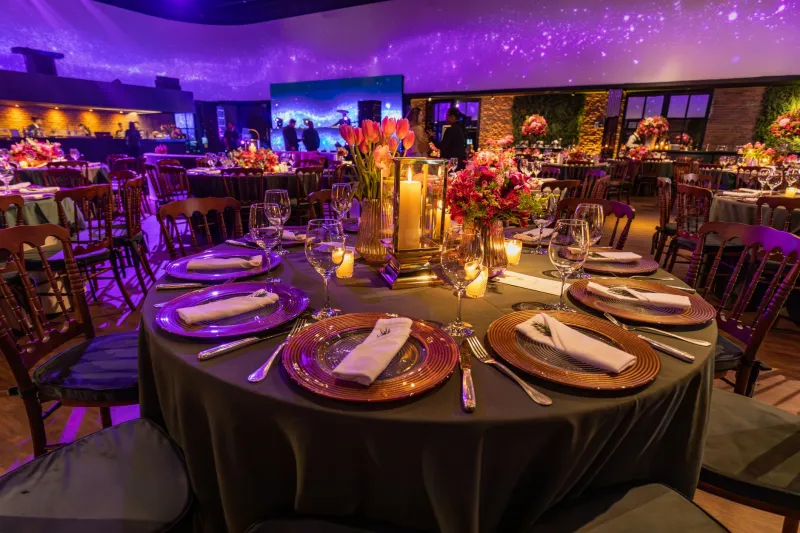
This is the principle of the focal point, and it is one of the most powerful tools in sophisticated event design. A reception with a modest overall budget but a single, extraordinary floral installation at its center will be remembered for that installation. A dinner with mid-range table settings but an exceptional lighting design will feel elevated beyond its cost. The strategic concentration of impact, rather than its even distribution, is what separates events that feel premium from those that merely cost a premium amount.
Designers who have worked consistently within budget constraints develop this instinct naturally. They learn to identify where a guest's attention will be drawn first, where photographs will be taken, where the emotional peak of an evening is likely to occur — and they invest there with precision, allowing other elements to recede into a well-executed but intentionally understated supporting role.
Reframing the Client Conversation
For clients approaching an event with a defined budget and ambitious expectations, the most productive conversation is not one about what must be sacrificed. It is one about what can be amplified. Constraint, reframed, becomes focus. A reduced guest count means more intimate programming. A smaller venue means more deliberate spatial design. A compressed timeline means a more curated selection of vendors and ideas.
The designers who consistently produce the most memorable events are not the ones with access to the largest resources. They are the ones who understand that every limitation is also a direction — a signal about where creativity should concentrate its energy. That understanding is not a workaround. It is the discipline at the core of serious event design.
At Quality Event Design, the approach to every project begins not with what is possible in the abstract, but with what is possible within the specific conditions of each engagement. Those conditions — the budget, the venue, the timeline, the client's vision — are not obstacles to great design. They are its raw material.